




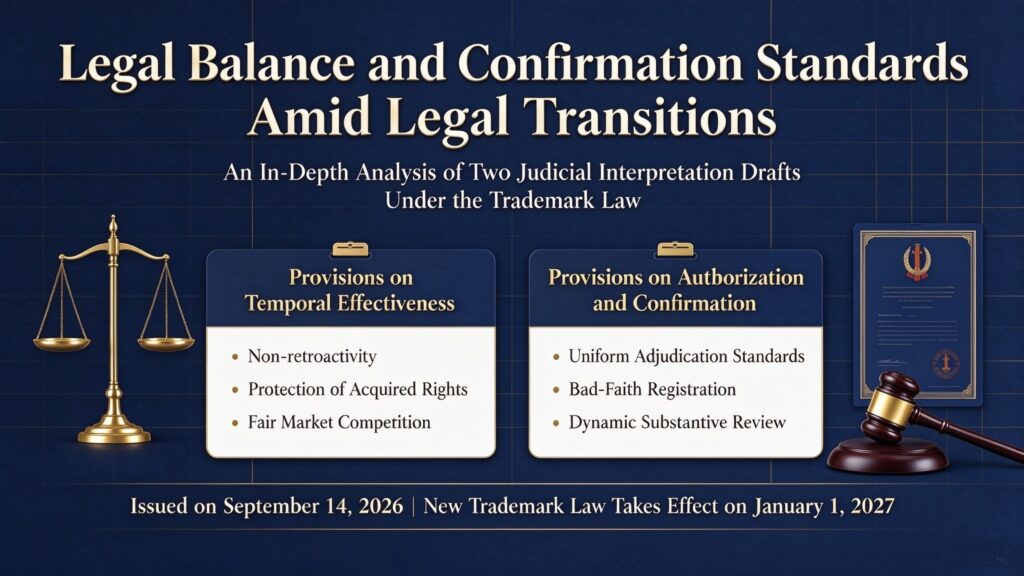
On 14 September 2026, the Supreme People’s Court of the People’s Republic of China officially released the Draft Provisions of the Supreme People’s Court on Several Issues Concerning the Application of Temporal Effectiveness to the Trademark Law of the People’s Republic of China and the Draft Provisions of the Supreme People’s Court on Several Issues Concerning the Trial of Administrative Cases Involving Trademark Authorization and Confirmation (including amendment decisions), inviting public feedback until 28 October 2026. Serving as vital supporting judicial interpretations for the newly revised Trademark Law – slated to take effect on 1 January 2027 – these two documents provide uniform adjudication guidelines for courts and administrative organs nationwide across two distinct dimensions: the smooth transition of temporal effectiveness and the precise unification of substantive standards for authorization and confirmation.
I. Part I: Provisions on Temporal Effectiveness
The transition period between old and new laws often triggers tension between the principle of non-retroactivity and substantive fairness. The temporal effectiveness provisions formulated by the Supreme People’s Court strike an optimal balance among legal stability, the protection of acquired rights, and the maintenance of fair market competition.
- Regulation of Continuing Infringements in Civil Disputes:
Trademark infringement acts occurring purely before 1 January 2027, are governed by the former law, while those occurring thereafter are subject to the new law. For continuing infringements spanning across the old and new legal regimes (such as multi-year online sales), the provisions explicitly dictate that the new law applies in principle. This framework dismantles the “safe harbors” previously afforded by legacy rules, enabling punitive damages and other powerful legal instruments against malicious infringement to directly target ongoing violations that continue to harm the market.
- Node Anchoring in Administrative Litigation and Examination Procedures:
To prevent “legal drift” during administrative lawsuits, the provisions stipulate that administrative actions challenging review decisions made by the State Council’s trademark administrative department shall be governed by the Trademark Law in effect at the time the review decision was rendered. This aligns with the administrative law doctrine that reviews of administrative legality should look to the norms active at the time of the administrative action. Meanwhile, proper transitional arrangements are established for procedural windows such as opposition periods.
- The Principle of “Applying the Older Law Unless the Newer Law is Lighter” for Administrative Penalties:
For administrative violations concerning trademarks, the rule of retroactivity follows the principle of favoring the relative when penalties are adjusted. If, by the time an administrative penalty decision is rendered, the new law no longer deems the act unlawful or prescribes a lighter penalty, the new law applies. This effectively safeguards the legitimate rights and interests of administrative counterparts and embodies modern principles of proportional punishment.
II. Part II: Provisions on Authorization and Confirmation
The draft provisions on trademark authorization and confirmation focus on “proper adjudication standards within administrative litigation concerning trademark authorization and confirmation.” Their revisions closely echo the new Trademark Law’s strict stance against malicious preemptive registration and address persistent pain points in judicial practice:
- Comprehensive Standardization of Institutional Nomenclature and Procedures:
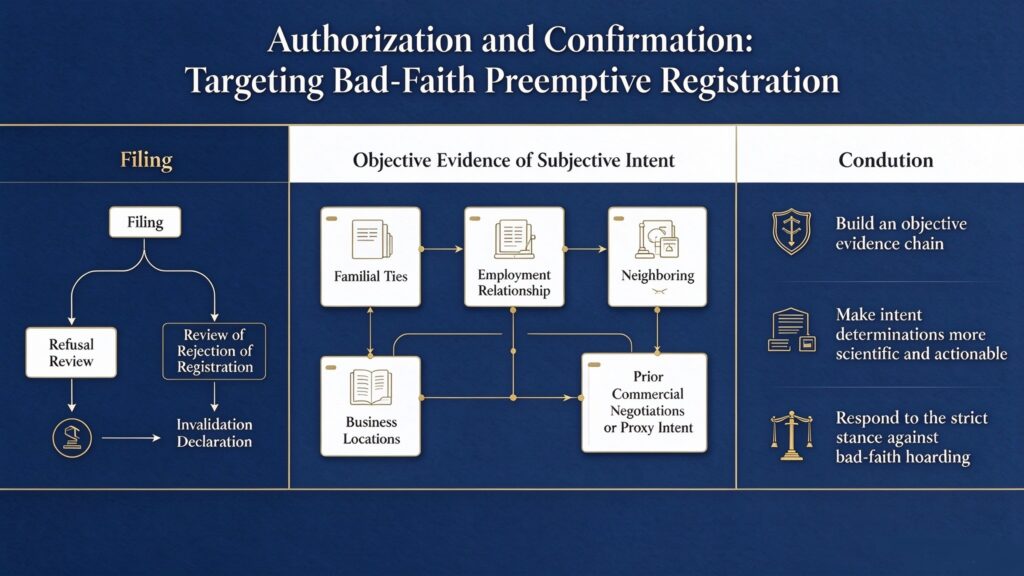
The text adapts all relevant institutional references to the “State Council’s Trademark Administrative Department” and accurately maps out various administrative actions—such as review of refusals, review of rejections of registration, and invalidation declarations—ensuring seamless integration with ongoing judicial and administrative institutional reforms.
- Precise Evidentiary Inference Standards for Malicious “Preemptive Registration”:
To address complex scenarios where prior users claim that an applicant acted with “intent to preemptively register” a prior-used, influential trademark, the draft further details objective evidentiary standards. By introducing objective evidence chains such as familial ties, employment relationships, neighboring business locations, or prior commercial negotiations and proxy intent, the determination of subjective “intent” becomes far more scientific and actionable, delivering a heavy blow to bad-faith hoarding.
- Resolving Judicial Bottlenecks Regarding the “Lapse or Revocation of Cited Trademarks”:
In response to complex dynamic shifts in judicial practice, the text introduces optimization mechanisms for situations where a cited trademark expires or is revoked during litigation. For instance, it incorporates a “change of circumstances” perspective within administrative litigation, substantively reviewing and dynamically addressing scenarios where a cited trademark’s legal foundation is extinguished due to non-renewal, voluntary cancellation, or legal invalidation. It clarifies disposal pathways where barriers to trademark registration are eliminated prior to the people’s court rendering judgment, avoiding mechanical jurisprudence and thereby substantially resolving administrative disputes while minimizing procedural burdens for litigants.
For the specific Drafts, please refer to the official website of the Supreme People’s Court at https://www.court.gov.cn/zixun/xiangqing/511791.html.
Disclaimer: This article is for reference only. Nothing herein shall be construed as Hong Kong legal advice or any legal advice for that matter to any person. OLN IP Services Limited shall not be held liable for any loss and/or damage incurred by any person acting as a result of the materials contained in this article.